
A Plan To Kill the Anti-Weaponization Fund? Is There An Expectation That The Liberal Judiciary Will Do The Dirty Work?
I suspect the Democrats, and some anti-Trump GOP, have a plan that could work because time is short -- defeating their effort will likely require the Trump Administration to defy the courts.

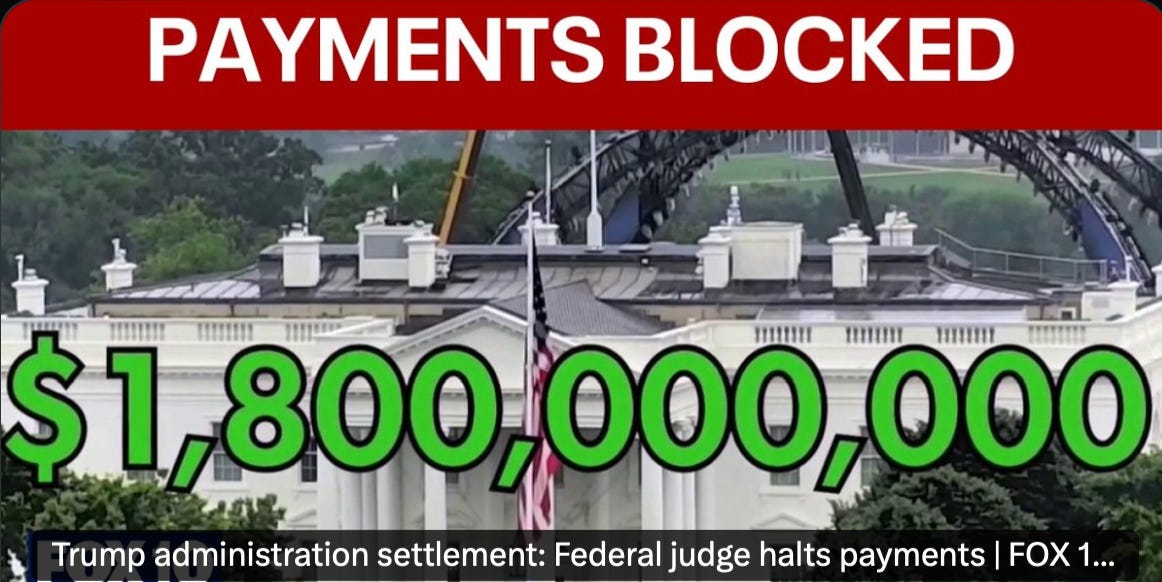
There are four legal actions that I am aware of seeking to challenge the validity of the Anti-Weaponization Fund (AWF) created by the Administration. The AWF ostensibly comes out of a “settlement” reached by members of the Trump family — including President Trump — with the IRS over the leak by an IRS contract employee of Trump tax returns while litigation was pending over production of those returns to Congress. The four actions are as follows:
By USCP Officers Daniel Hodges and Harry Dunn in the D.C. District Court who were present at the Capitol on January 6 during the riot.
By CREW — “Citizens for Responsibility and Ethics in Washington” — also in the D.C. District Court.
By former DOJ Prosecutor Andrew Floyd in the Eastern District of Virginia federal court.
The last is not a complaint, but a motion to reopen the case filed by Trump and his family members in the
The lawsuits all lack merit. The DOJ has authority given to it by Congress to settle litigation — or even claims filed prior to litigation — with money allocated to it in an annual appropriation to the “Judgment Fund.”
DOJ represents the federal government in thousands of civil actions seeking money from it. DOJ is not required to obtain court approval in advance of settling claims, nor is there any jurisdictional basis for a court to seek to intervene in such settlement that have never been filed in an Article III Court. Congress has vested this authority in the Executive Branch without providing for judicial review, and any interference by district judges is likely violation of “Separation of Powers.”
But statutes expressly stripping district courts of jurisdiction haven’t proven to be much of a barrier to liberal/progressive federal district judges over the past 17 months — and I fear it is not going to slow down at least two of the judges involved in the cases noted above.
The motion filed by 34 “Former Federal Judges” — they either quit or retired rather than take Senior Status — in the Southern District of Florida is almost certainly to be meaningless. The announcement was that Pres. Trump was dismissing all claims by him and his family members in exchange for the IRS funding the “Anti-Weaponization Fund” in the amount of $1.776 billion dollars to settle claims brought by persons who claim to have been victimized by the Department of Justice during the past 10 years. The Judge in that case, and Obama appointee, issued an order last week directing the plaintiffs attorneys — not DOJ — to respond to allegations that the lawsuit was a fraud on the Court. But all she is suggesting by her order is that those attorneys might be open to Rule 11 sanctions if she concludes that the entire episode of filing a complaint for $10 billion and then settling for the creation of the AWF was a sham from the start. She’s already dismissed the complaint with prejudice, and she her order makes clear the “settlement agreement” — whatever its genesis — is not part of the record of the case. There really is nothing for her to do with regard to the settlement — she can’t “void” something that was never before her. But, as I mentioned above, the “settlement” is not necessary to what the Administration is proposing to do via the AWF.
Let’s remove this from the context of President Trump and his family to provide a plausible real-world scenario to explain how this process works entirely independent of the judiciary.
Suppose there is an airplane crash that kills all 300 people on board. Let’s say that a malfunction by FAA equipment is claimed to be the primary cause that led to the plane to crash — no pilot error, no mechanical failure, etc., — just an FAA equipment malfunction that led to flight control inputs resulting in 300 deaths.
To be compensated for the trauma of losing their loved ones, the families would file 300 separate claims against the FAA for negligence, a claim for which Congress has waived sovereign immunity under the Federal Tort Claims Act.
DOJ can settle those claims prior to the families filing a complaint in federal court alleging negligence. The paperwork looks nearly the same as in a court case, and the money comes from the same source as money used to settle court cases — the Judgment Fund. The authority to enter into such pre-filing settlements is part of the Federal Tort Claims Act.
Claims made to the AWF to compensate victims of “weaponization” by the DOJ over the past 10 years are no different than claims filed as a result of the airline crash caused by government negligence. Once DOJ accepts the validity of a claim and decides it is appropriate to settle the matter by paying some/all of the amount claimed, that is the end of the process. The money comes from the appropriation that Congress gives to DOJ every year for that purpose. There is no judicial review.
So, what is the problem?
I fear it is going to end up being the judges who are now assigned the cases, and the Appellate Circuits in which they sit.
